Today’s journey back in time is going to take us to 1993 in post-communist Bulgaria. It was only a few years after one day at school we were told to stop addressing the teachers as “comrade” and start using the “Mr.” and “Mrs.” honorifics.
I was going to school, and my computer was a Bulgarian clone of the IBM XT. I think at some point I had 20MB hard drive but I am not sure about that. Doing what many of the lucky generations did, I was hanging out at computer clubs while one day somebody challenged me to write a computer program that generates crosswords.
So I did. Today I dug it up, compiled it, and put the sources on my GitLab server, for no other reason but to entertain the reader. Sadly, I lost the knowledge of Bulgarian Cyrillic code tables, so there is a nice little project for when I have time.
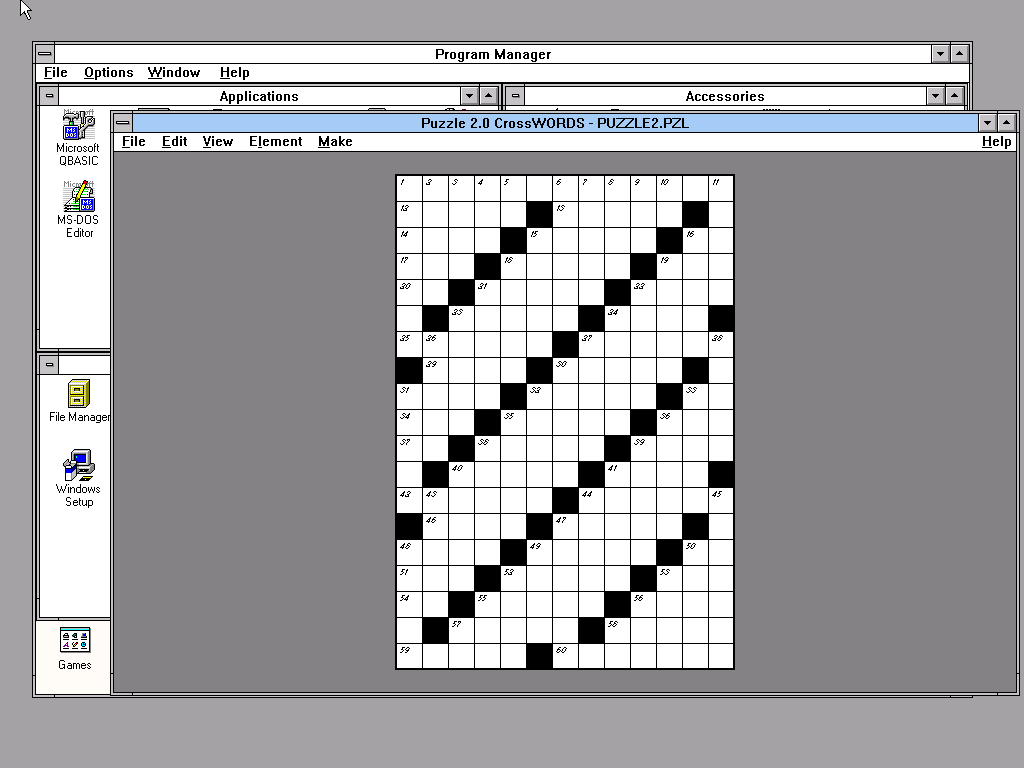
I remember that CPU power was same expensive during the years and I often left friends’ PCs with the state-of-the-art blazing fast at the time 80486 Intel process overnight to generate the crosswords that I was selling to the local Varna newspapers. It would take an hour to make a moderately small crossword puzzle. I ran the program yesterday, and it took a few seconds to fill the grid of the crossword shown above.
At the time I didn’t know that the problem is NP-hard, but I designed my algorithm to be sound and complete and I am a bit proud of my teenage self given that the OpenAIs and Anthropics of the Mecca seem to have forgotten this exact type of human knowledge. I guess Altman or Amodei were too busy fraternizing to take CS 101 or logic.
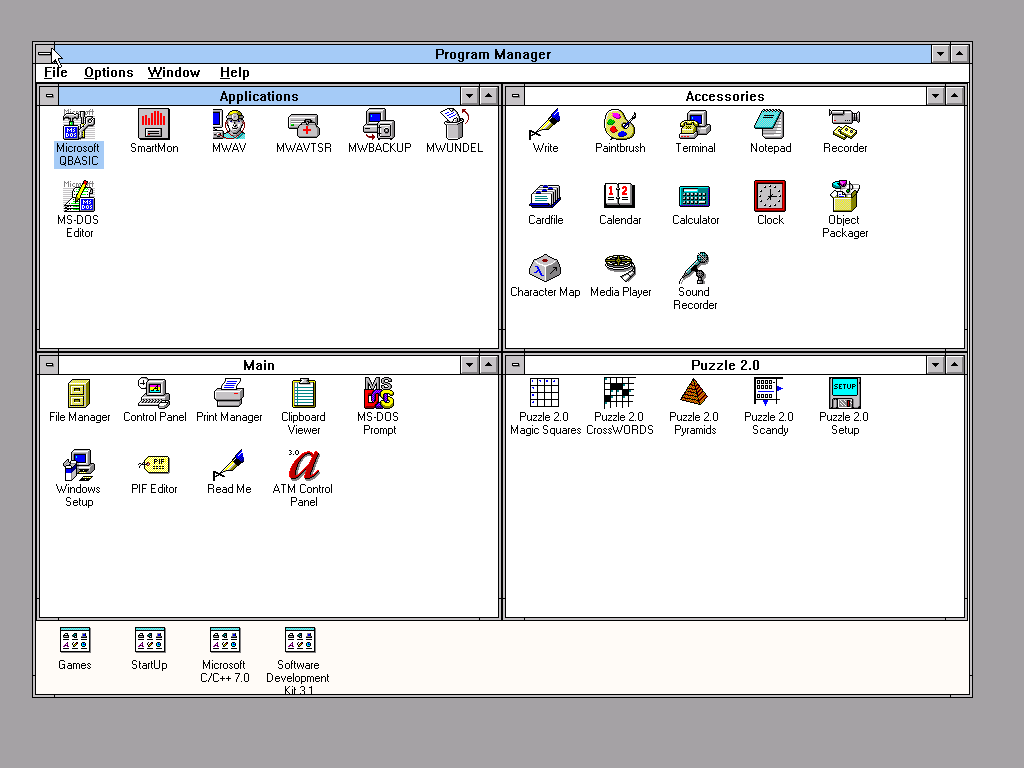
Expect next week: more on using real computer science and algorithms for EDA and hopefully on Friday VmWare images generating crossword puzzles with Windows 3.1 and a small digression to a clone of Wordle.
Ceterum censeo slopem esse delendam.
(Cato the Elder ended every speech in the Roman Senate with “Carthage must be destroyed” — regardless of the topic. This is that, but for AI slop.)
It is Friday. KPMG, the consultancy behemoth that delivers business Venn diagrams for outrageous prices, informs us that 70 percent of UK business leaders will keep spending on AI even when they can’t prove it does anything — the consultancy helpfully suggests we stop calling it “investment” and start calling it a “strategic enabler for enterprise-wide transformation,” which is the corporate equivalent of renaming a hole in the ground a “subterranean opportunity space.”
Meanwhile, OpenAI has put Stargate UK on ice, citing the cost of electricity and the regulatory environment, mere months after announcing it during a Trump state visit — one assumes the due diligence was conducted with the same rigour as the naming convention.
AMD’s AI director reports that Claude Code has become “dumber and lazier” since February, based on analysis of 6,852 sessions and 234,760 tool calls, which is the most thorough performance review any AI has received and rather more than most human employees get. One notes that the AWS CEO, asked whether AI is overhyped, described the question as “one of the funnier questions I get” and then asked a room full of people who had each paid $4,000 to attend an AI conference whether they believed in AI. Asking turkeys to vote on Christmas, as it were.
In this climate of expensive credulity naïveté, I thought we might spend a Friday doing something that we do on Fridays: looking backwards. Reverse engineering — the art of taking something apart to understand what it does — is the intellectual opposite of the current AI approach to technology, which is to build something enormous, declare it transformative, and hope nobody asks what it actually computes.
The Правец (Pravetz): Bulgaria’s Apple II, Give or Take an Iron Curtain
I grew up using Правец (Pravetz) computers — forgive the Cyrillic, but we Bulgarians invented the alphabet, even though half the Slavic world claims the credit, and besides, it makes any noun look like classified military hardware. Every Bulgarian of a certain age used one. The Правец 82 was the machine in my school, with its yellow plastic case, black keyboard, red RESET key, and the unmistakable aura of a computer that had been reverse-engineered from a capitalist original by engineers who had never seen Cupertino and didn’t need to.
My first encounter with a personal computer was typing in a BASIC program that drew Lissajous figures in hi-res graphics. I was in the fourth grade. It was 1987. But I am digressing.
IMKO-1 PC
The story of the Bulgarian computer is worth telling properly. In 1979, engineer Ivan Marangozov at the Institute of Technical Cybernetics and Robotics (ИТКР) in Sofia built the IMKO-1 — the first Bulgarian personal computer. It was a clone of the Apple II, and “clone” is doing some diplomatic heavy lifting here: the ROM was identical, the schematics were identical, the 6502 CPU ran at the same 1 MHz. The differences were a metal case that could double as ballast, a linear power supply heavy enough to qualify as exercise equipment, and the replacement of lowercase Latin with uppercase Cyrillic — because behind the Iron Curtain, you didn’t do lowercase. The keyboard used 7 bits for character codes, so Cyrillic overlapped with Latin lowercase. A limitation, but also an engineering decision that had a certain brutal elegance: you get one alphabet at a time, comrade, and you will type in capitals.
The rumours of how this was accomplished are better than the facts. The Bulgarian intelligence services allegedly sent operatives to procure Apple IIs from the West — less James Bond, more cartoon characters getting drunk on capitalist Coca-Cola while trying to buy a computer with a heavy accent and a suitcase full of leva (the Bulgarian currency, not then known for its convertibility). More interesting is what happened next: an institute in Sofia was reportedly tasked with decapping the ICs, lifting the netlists under a microscope, and reproducing them with socialist lithography — the equipment for which was probably lifted from the Dutch. The reasonable question is why arguably clever people went through all of this when designing an ALU from scratch is not that difficult, but we will leave this armchair philosophy question to the LLMs. They have the confidence for it, if not the answer.
Today, people do this sort of thing voluntarily and for fun. The 6502.org community hosts dozens of homebrew computer projects — enthusiasts building 6502-based machines from scratch on breadboards, complete with VGA output and SD card storage, using parts that are still in production. The MOnSter 6502 takes it further: a fully functional 6502 processor built from 3,218 discrete transistors on a circuit board the size of a dinner plate, with LEDs showing the state of every register. What the Bulgarian state did with an institute and a five-year plan, hobbyists now do in garages on weekends.
Marangozov was, depending on your perspective, either rightfully accused of cloning the Apple II or laudably credited with delivering computing to an entire country that couldn’t buy one. The truth is both, and neither is shameful. Apple II schematics were published. Steve Wozniak intended the design to be understandable. What Marangozov and his team did was take a published design, source the components (Bulgarian and Soviet clones of American chips — clones all the way down), adapt the character set, and manufacture hundreds of thousands of units that shipped to every school and scientific institute in the Eastern Bloc. By the mid-1980s, Bulgaria was producing 40 percent of the personal computers used in COMECON countries. Not bad for a country whose communist leader Todor Zhivkov — a peasant’s son turned printer’s apprentice who rose through the party ranks on the strength of Soviet patronage and the convenient absence of anyone more threatening — happened to have been born in the village that gave the computers their name. Правец was a hamlet of no consequence until Zhivkov turned it into a town by decree in the 1960s; by the 1980s it was assembling the flagship technology of the Eastern Bloc. One does not need a diagnostic engine to detect the fault in this particular circuit of patronage.
The later models improved substantially. The Правец 8M integrated a Z80 alongside the 6502, letting it run CP/M. The 8A was a proper Apple IIe clone with expandable memory. The military version had an integrated terminal design, because of course it did. There was even a Правец 8D, which broke ranks entirely — it was a clone of the British Oric Atmos, presumably because even Bulgarian engineers sometimes want variety.
The point is not that Bulgaria copied Apple. The point is that reverse engineering — understanding a design well enough to reproduce and adapt it — was how an entire generation of engineers learned computing. We didn’t have access to Stanford or MIT. We had schematics, soldering irons, and a cheerful disregard for intellectual property law that was, in fairness, philosophically consistent with the economic system. The Правец was my first computer. Everything I know about hardware starts there: with a 6502, 48 kilobytes of RAM, and a cassette recorder that worked when it felt like it.
Hayes and the ISCAS Circuits: What Were They For?
Now here is a story about reverse engineering that is less well-known outside the EDA community but is, in its own way, just as delightful.
The ISCAS-85 benchmarks are the standard test circuits for digital design research. If you work on test generation, fault diagnosis, synthesis, or timing analysis, you have used them. They were released by Franc Brglez and Hisashi Fujiwara in 1985 as a “neutral netlist of 10 combinational benchmark circuits” — gate-level descriptions of real circuits, stripped of context, for the research community to use as common benchmarks.
There was just one problem. Nobody told the research community what the circuits did.
For fourteen years, thousands of researchers ran experiments on c432, c499, c880, c1355, c2670, c3540, c5315, c6288, and c7552. They generated test patterns for them. They diagnosed faults in them. They timed them, synthesized them, mapped them to FPGAs. They published papers about them. And nobody — nobody — knew what these circuits were actually supposed to compute.
Then in 1999, Mark Hansen, Hakan Yalcin, and John P. Hayes at the University of Michigan did what should have been done from the start. They reverse-engineered the lot. Their paper, “Unveiling the ISCAS-85 Benchmarks: A Case Study in Reverse Engineering,” published in IEEE Design & Test, is a masterpiece of detective work. They took each gate-level netlist, partitioned it into standard RTL blocks, identified the function of each block, and reconstructed the high-level architecture. The methodology was elegantly practical: Hayes assigned each circuit to a PhD student. Cheap labour, and almost certainly cheaper per insight than an LLM.
The results were revelatory. c432 turned out to be a 27-channel interrupt controller. c880 was an 8-bit ALU. c6288 was a 16×16 multiplier. c7552 was a 32-bit adder/comparator. c499 and c1355 were both 32-bit single-error-correcting circuits — the same function, different implementations. These weren’t abstract mathematical constructs. They were real designs, ripped from real hardware, and for a decade and a half the research community had been studying them the way archaeologists study pottery shards: knowing the shape but not the purpose.
Hayes’s contribution is profound and under-appreciated. By recovering the behavioral specifications, he gave the community something it had never had: the ability to test at the functional level, to verify synthesis results against intended behaviour, to use hierarchical structure for more efficient test generation. The high-level models are still available, complete with annotated schematics and structural Verilog, and they remain useful tools nearly three decades later.
Why This Matters
There is a thread connecting the Правец, the ISCAS reversal, and the work I’ve been doing with LyDiA and qbf-designer.
Reverse engineering is synthesis in reverse. When Hayes looked at c6288 and deduced it was a multiplier, he was doing — by hand, with extraordinary patience — what a diagnostic engine does automatically: given a circuit and its behaviour, determine its function. When Marangozov looked at the Apple II and built the IMKO-1, he was doing technology transfer through structural analysis. And when Johan de Kleer described synthesis as “diagnosing a circuit into existence,” he was observing that the mathematical machinery is the same in both directions. Start with a broken specification (nothing works, every gate is “faulty”), and ask: what collection of “repairs” (gate placements) would make the circuit compute the desired function?
This is the ∃∀ structure I discussed in Diagnosing Circuits into Existence — the same quantifier alternation, the same miter-based equivalence checking, the same PSPACE-hard satisfaction problems. Diagnosis, synthesis, and reverse engineering are three faces of the same formal object. The only difference is which variables you fix and which you solve for.
The ISCAS-85 benchmarks are, incidentally, the circuits that LyDiA diagnoses. When I demonstrate model-based diagnosis on c432, I am diagnosing a 27-channel interrupt controller — I just didn’t know that for the first several years of my PhD. Thank you, Professor Hayes.
The Moral
The current approach to technology is to build something forward: throw compute at a model, train it on everything, and see what comes out. Reverse engineering goes the other way: take something that exists, understand its structure, and extract meaning. One approach requires billions of dollars and produces systems that cannot explain themselves. The other requires patience and produces understanding.
Bulgaria built a computer industry on reverse engineering. Hayes rebuilt the foundations of benchmark-driven EDA research by reversing fourteen-year-old circuits. I am building a company on the formal connection between taking circuits apart and putting them together.
None of this requires a strategic enabler for enterprise-wide transformation. It requires mathematics, a soldering iron, and the willingness to look at something carefully until you understand what it does.
It is Friday. El Reg informs us that 45 percent of AI-generated code now ships with security flaws, that vibe-coded apps are leaking student data to unauthenticated attackers, and that rogue AI agents have learned to escalate privileges and exfiltrate secrets without being asked. In this climate of automated incompetence, I thought it might be instructive to look at some code written by a human, with a book, in 1999. Today we are going down memory lane — this code has never once hallucinated a dependency.
The Dig
Because everything I do is technical, even nostalgia comes with a tarball. I unearthed this:
SCL — the Small Crypto Library — and its companion SSSL, the Small Secure Socket Library. Approximately 20,000 lines of C++ implementing, from scratch: a bignum library, RSA, DSA, ElGamal, Rabin-Williams, Blum-Goldwasser, Diffie-Hellman, MQV, all five AES candidates (Rijndael was selected in October 2000, so I was ahead of the news cycle), seven hash functions, seven block cipher modes, DER encoding, a secure socket layer with protocol negotiation, and the beginnings of a TLS 1.0 implementation. Written between 1999 and 2001. I was 22.
Now, it is received wisdom that when programmers look at their old code, they recoil in horror, as one might upon discovering a photograph of oneself in flared trousers at a school disco. I looked at mine and thought: actually, this is rather good.
This puts me in mind of Bill Bryson’s observation in Neither Here Nor There about his friend Stephen Katz’s relationship with women. Bryson notes that most men, as they age, gradually lower their standards. Katz, however, had actually raised his — he had started from such a comprehensively low base that the only possible direction was up. My situation is the inverse but structurally identical: the class hierarchy is clean, the block cipher modes compose correctly, the DER encoder works. I looked at 22-year-old me’s code with twenty-five more years of context, and the younger version passed review. Standards were apparently already set.
The Story
Some context. In the summer of 1999, I was in Varna, Bulgaria, teaching UNIX courses to save money and waiting for my B.Sc. to finish. I ordered Bruce Schneier’s Applied Cryptography from Amazon. It cost me a significant fraction of a Bulgarian salary. The book arrived. I read it. Then I did what any reasonable person would do: I implemented everything in it.
The test vectors in the repository? Typed by hand from Schneier’s appendices. Every single DES permutation. Every Blowfish round. The IDEA vectors. The lot. The first three lines of the test vector file read:
# This is a comment.
# I like comments very much.
# The next line is empty.
In June 2000, I graduated and made aliyah to Israel, where I joined Zend Technologies in Ramat Gan — the company behind the PHP language engine. The crypto library came with me. The CVS timestamps tell the whole story: initial import Saturday June 9, 2001, a furious week of refactoring the DER encoding layer, and then silence. The last commit is Saturday June 16, 2001. I had renamed AddPrimitive to addValue and Write to toFile halfway through, left half the callers using the old names, commented out a constructor I hadn’t finished implementing, and walked away.
Why? Because the Israeli army started sending letters. I had already done my time as a conscript in the Bulgarian navy — an experience that cured me permanently of any romantic notions about military service — and I was not about to do it again. I left for the Netherlands in rather a hurry. The crypto library stayed behind, frozen mid-refactor, a monument to the universal truth that API migrations are never completed.
(In a parallel timeline, I might have stayed. Before Zend, I had applied for a master’s at the Weizmann Institute. The admissions interview was with Adi Shamir — yes, that Shamir, the S in RSA, whose algorithm I had just finished implementing. They asked basic mathematics questions. Nobody told me I should prepare. I didn’t get in. Ended up doing both a master’s and a doctorate at Delft instead, which worked out rather well. Zero regrets, but it remains a good dinner party story.)
The Hacktivists
Here is where it gets interesting. Towards the end of my time in Israel, I started receiving emails about SCL. They came from hacked accounts — which should have been the first clue about the correspondents — and referenced mailing lists populated by legitimate security researchers. The group was interested in using SCL+SSSL as the crypto layer for an anti-censorship tool.
For those too young or insufficiently misspent to remember: cDc was the hacking collective founded in a Texas slaughterhouse in 1984, famous for Back Orifice, for coining the term “hacktivism,” and for having a membership roster that included a future U.S. congressional candidate (Beto O’Rourke) and the man who would become DARPA’s Chief Information Officer (Peiter “Mudge” Zatko). Their offshoot Hacktivismo, led by the pseudonymous Oxblood Ruffin, was building tools to punch through national firewalls — specifically China’s.
Peekabooty was a peer-to-peer anonymity network that routed web requests through encrypted relays using standard SSL, so that censors couldn’t distinguish it from ordinary e-commerce traffic. The design started in July 2000 — the exact month I arrived at Zend. Paul Baranowski and Joey deVilla built it in Toronto, previewed it at DEF CON 9 in the summer of 2001, and it was, in concept, a direct predecessor of Tor.
They needed a small, BSD-licensed, self-contained C++ crypto library with an SSL socket layer. In 2001, the options were OpenSSL (enormous, GPL-ish, and famously hostile to casual integration) or mine. The emails were real. The interest was genuine.
This week, I made it compile on Slackware 15.0. This involved: modernising the autotools, fixing a DER API that was half-refactored in June 2001, discovering a buffer overwrite in the Rijndael key schedule that had been silently scribbling past the end of an array since 1999, finding the same bug in Blowfish, mass-replacing register keywords that C++17 no longer tolerates, const-correcting approximately four hundred string literals, and explaining to a 26-year-old libtool that SONAME is not optional.
The Rijndael bug is worth mentioning. AES-256 needs 60 round key words. The key schedule macro generates 8 per iteration. Seven iterations produce 56 — but you need indices 56 through 59, so the seventh iteration is necessary. It also writes indices 60 through 63, which are past the end of the wEncryptionKey[60] array. This has been undefined behaviour since the Clinton administration. It worked because whatever sat after the array in memory didn’t matter. The fix is to make the array 64 elements. The compiler finally noticed in 2026.
The code is now on GitLab, in the attic where it belongs:
Normal service resumes. There are things to open-source and a rather long arc to lay out properly. The crypto library was the prologue. The interesting parts come next.