It is Friday. The French used to say “Le roi est mort, vive le roi!”. For those of us raised with less melodious languages, this means “The king is dead, long live the king!” And since we don’t use guillotines to kill humans anymore, our brightest and most capable chant in media something alongside “Mathematics is dead. Long live mathematics.” Keep in mind that computer science (and AI by extension) is just B-rated mathematics for people who didn’t study for their exams because they spent too much time playing video games or fraternizing with their Greek-letter friends at business school.
Now let’s talk about open problems and OpenAI allegedly closing millennial mathematical problems, and scientists and other folks crying. Oh well, mathematicians cry because of all these suppressed emotions, but that is something for the shrinks to weigh-in and I am not a shrink (admittedly most of my knowledge about psychology comes from watching The Sopranos, reading Phillip Roth, and reading the Wikipedia article on Sigmund Freud).
Back to OpenAI solving millennial problems. We like lists, don’t we? It is very satisfying to check every item in a list. It sure beats bubble-wrap. Of course the proverbial million-dollar questions are: what is this all good for, can we (anybody) actually make sense of the results, and are the results any correct? Well, before solving millennial problems, opening the gates to million-dollar stipends, lecture halls full of applauding people and economy-plus-paid conference travel, there used to be all kinds of competitions and challenges. Remember the machine-learning Netflix challenge to predict movie watching (and the million-dollar prize)?
Also, remember the Euler problem website where I spent 3-4 moderately happy do-nothing days during my Ph.D. years? One had to solve, mostly, number-theoretical problems of increasing difficulty, and one got some badges and stars and their name in a leaderboard, so one could boast to their geek friends. At some point, I solved all hundred problems, but soon after additional problems emerged, and I was bored, and I moved on, and the world moved on as well.
Talking about problems and competitions, I spent a lot of time on a project called “The International Diagnostic Competition”. This was collaboration between NASA and Xerox PARC, and I spent one year setting-up the competition, and PARC synthesized diagnostic challenges based on small chip designs, and NASA provided data about the electrical simulator they had. NASA’s simulator was an expensive room somewhere around Moffet Field, full of fans and light bulbs and buttons (rumor went there was a solar panel on the roof).
The details escape me, but I believe there were three submissions: one from me, one from my manager Johan, and one from Sweden (where the DX workshop was this year). I think my algorithm won, but that is probably because I generated the problem formulation and the problems and the metrics for ranking the solutions. I should have let Johan win because he was my PARC manager, and it would be better for my career and everything.
The general conversation from those times though resonates in my head: your algorithm is faster but my uses less memory and yours has more false positives but mine has less false negatives and even second graders know false negatives are more important than false positive but you give permission for travel expenses and you are someone who influences the lab manager who badly wants to be a CEO so he can buy the cheapest Porsch so you win!
Then there is the satisfiability competition. Boolean satisfiability is a well-defined computer science problem, and people agreed the CPU time matters most and that there is a single (process) thread and also a parallel SAT thread. But then somebody was clever enough to make use of cache memory in a better way or something, and is this true algorithmics (like B-rated mathematics) or is this a con job?
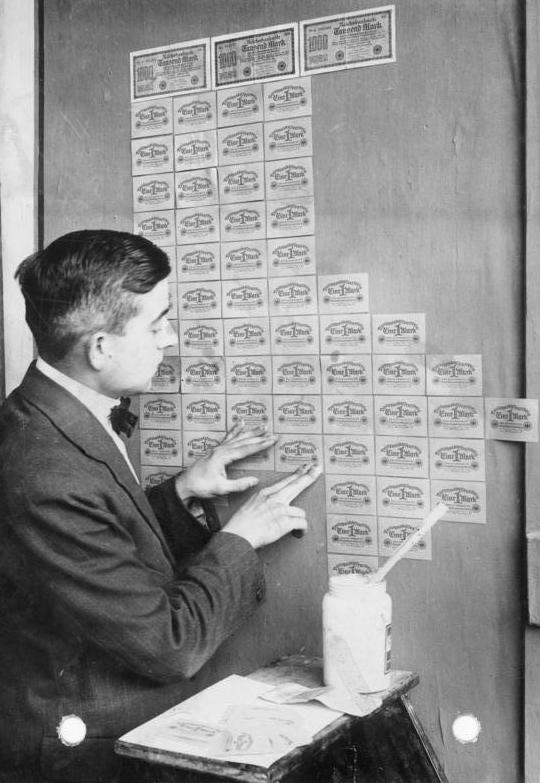
Every so often I glimpse into the state of LLMs, and then I see a million benchmarks about translation and mathematical problem solving and everything else. Oh well, isn’t the list with all open mathematical problems also a kind of benchmark? Don’t worry! There will be a benchmark and a prize for everyone. If you won nothing, just invent a benchmark and a solution. And, well, maybe you can make your desired millions or billions. With this inflation, soon we will use wheelbarrows to carry money around. The photo below is from postwar Germany when inflation was so high that a loaf of bread cost a billion marks. The very inflation that the unsustained ambitions of Silicon Valley will fuel.
Inflation in the Weimar Republic: an artist using paper money as a cheap wallpaper substitute. Photo taken from Wikimedia.
Now, now, the AI believers will say. AI, besides consciousness will develop superb diagnostic and prognostic abilities and will predict all failures, human or machine. Here, sincerely yours, clears his throats sips his water and prepares his editor for writing a bit more about the process of diagnosis as a whole. Today we will talk about less mind boggling concepts such as AI consciousness and world domination and more about what it actually takes to perform real diagnosis.
Let’s say that your boss comes to you and tasks you to diagnose something important: like a spaceship or motor rickshaw (doesn’t matter what, some system). Being cool and desiring to be gainfully employed for months and possibly until retirement you start talking about the multiple phases that will eventually result in something that is going to watch the spaceship or the motor rickshaw for failures (such as the dreaded engine maintenance light in your car). The phases are depicted in the diagram shown next.
We always start with some engineering description of what we are going to model. So we describe each component in the spacecraft (thrusters, antennas, tractor beam generators, etc.) in some formal or less formal language (think of Matlab, Python, or database schemas).
What comes next and where LLMs and AI totally fail is fault-modes. So nobody designs devices (spaceships or not) to fail. Moreover, things hopefully fail relative rarely. And when they fail they typically do quickly and with a bang. And during this failure, it is probably your least priority to measure temperatures, pressure, and voltages and more like to duck and avoid the shrapnel.
To run diagnosis we need to know how components fail. Since I proudly dissociate myself from the Californian AI companies, I will insist that all experiments are precise and reproducible. In other words and unlike the charlatan CEOs, I didn’t miss my science and engineering classes at college. The data collected is for building physics-inspired models or train machine-learning data, if you wish, but the most important aspect of this reproducibility is that we will be able to compare diagnostic approaches and systems in terms of Key Performance Indicators (KPIs), or diagnostic metrics if you wish. Everybody has heard about diagnostic metrics of various medical tests such as false-positives and false-negatives, but there are many more such as diagnostic accuracy, or even if you wish the amount of the super-expensive RAM due to the AI craze we have.
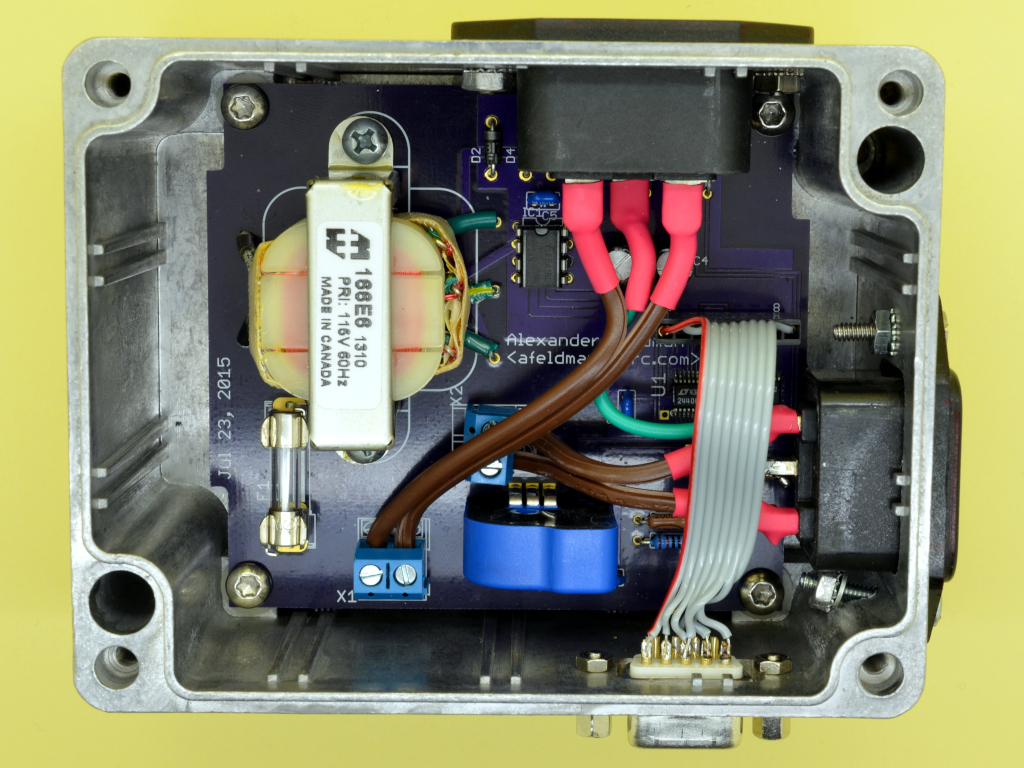
Ex-Parrot evolved from work that I did for PARC ten years ago. PARC wanted to diagnose systems and I was interested in air conditioners (as I live in California, it is hot, and air conditioners fail a lot) but nobody would let me diagnose a real air conditioner. So I went to Walmart and bought the closest to an air-conditioner which turned out to be a hundred dollar refrigerator (I charged the company credit card). Then I took a pair of pliers, cut through many wires and instrumented the refrigerator. Of course, I wanted to know precise temperatures and voltages and other data, so I constructed a lot of hardware.
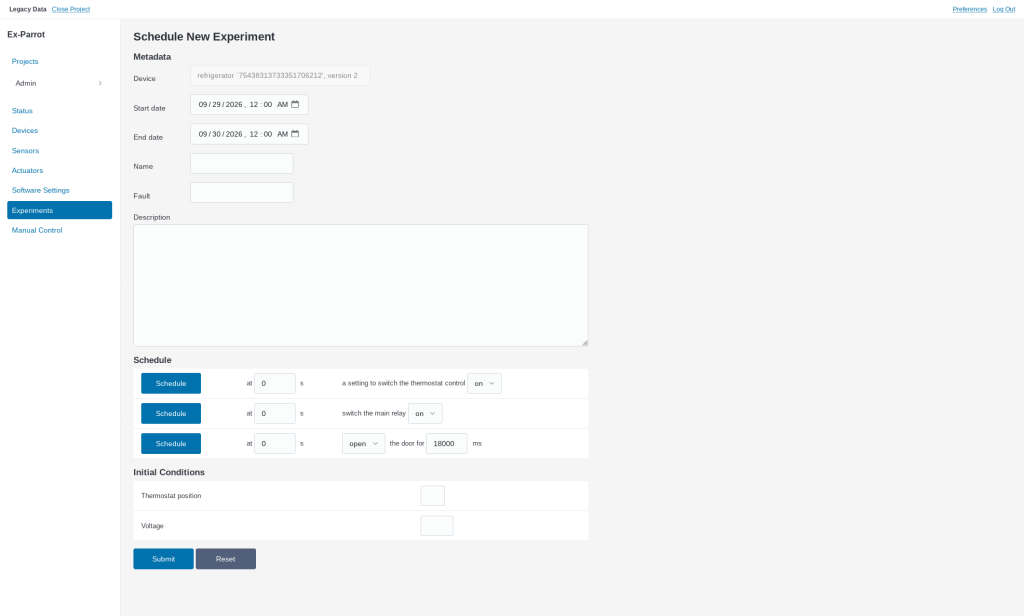
One of the main novelties of Ex-Parrot is that it knows and one can schedule a diagnostic experiment. You just go to the web front-end, click a few buttons and start scheduling commands such as “toggle a relay” or “start a motor”. If the need arises, I will added the functionality to have LUA scripts, right now it is just a linear sequence of commands.
An Ex-Parrot diagnostic experiment is a sequence of commands. In the refrigerator use-case, for example, the scenario would do nothing let’s say for four hours, then it would open the door to simulate a leak of thermal energy and then it would close it and again do nothing for some number of hours. The best part is that the whole experimental design can be done easily and with a tool that is shown next.
Neither obscure scripting skills nor agents are required to create a diagnostic experiment
Running the script would execute the commands and produce dramatic videos like the one below.
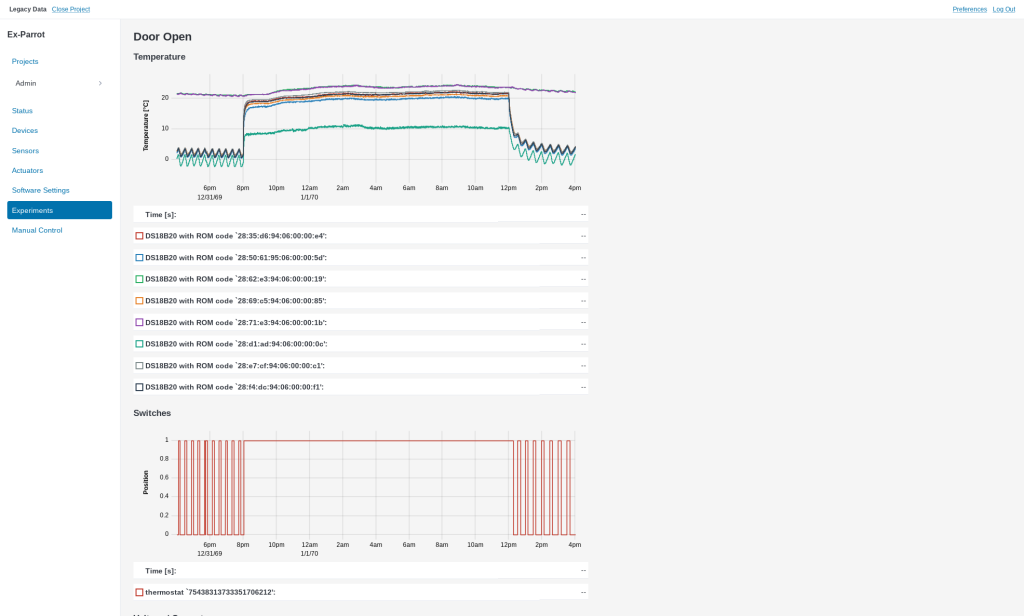
Of course, while playing all these commands to physically simulate a hardware failure Ex-Parrot collects and stores and the sensor data. In the screenshot below you can see the temperature corresponding to the above opening and closing of the door. As you can see in the first four hours the thermostat turns the compressor on and off and then when the door is opened the compressor stays on but the temperature inside the fridge is very close to the temperature outside of the fridge.
The data is still available and can be used as a benchmark. I collected temperatures at many locations and even high-frequency voltage and current data. Soon there will be a public demo version of Ex-Parrot where users will be able to create a read-only account, browse the fridge data and even export it as HDF5 files for their own diagnostic and prognostic algorithms.
Ex-Parrot is to be combined with another software platform, called Psycho-Killer which takes the instrumented data and analyzes the performance of various diagnostic approaches.
What will come next is a live demo of Ex-Parrot (read only, no actuation for demo accounts) and I am also developing a real sensing network with temperature and vibration sensors that will talk to Ex-Parrot via Matter. These sensors and the Ex-Parrot cloud service will be for sale so you can instrument your own devices.
Before we close with the usual anti-AI chant, here is a taste of marketing and a bit of my plans. The old adage garbage-in, garbage-out is valid. Do you think you have a system that can benefit from good diagnostics and prognostics? Do you trust me that failure data is valuable and missing and if we capture it, we will be able to use it and sell it to other people who want to do diagnostics and prognostics? If so, give Llama Logic a call or drop a note and let’s do some quality diagnostic and prognostic engineering together!
Ceterum censeo slopem esse delendam.
(Cato the Elder ended every speech in the Roman Senate with “Carthage must be destroyed” — regardless of the topic. This is that, but for AI slop.)
Stanford researchers reported this May that robot policies scoring close to 90 percent in controlled simulation succeed at roughly 12 percent of real tasks; on a published peg-insertion benchmark one method managed 98.75 percent in simulation and 12.5 percent on hardware. The robots failing is not the interesting part. The interesting part is that nothing in the simulated score announced they would — the number was confident, precise, and silent about its own irrelevance. A method that cannot signal its own failure is worse than a mediocre one that can. Remember that; one of the ten methods below fails spectacularly, and the manner of its failure is the most reassuring thing in this post.
Psycho Killer
Today I am releasing psycho-killer, a toolkit for model-based diagnosis of dynamical systems. The name is a Talking Heads reference.
It is not a diagnosis algorithm and ships no opinion about which method you should use. It is a framework for diagnostic analytics: one system model, one shared set of fault scenarios, every applicable method run against them — filter-based and data-driven alike — scored on the same metrics. The output is not a diagnostic algorithm, it is a table you use to choose a diagnostic method, which is different and more useful.
It also ships a graphical IDE, and the GUI is the point. An engineer who has never opened a Python interpreter can load a model, inject a fault, watch the tanks respond, and get the comparison table out the other end — precisely the audience that ought to be doing model-based diagnosis and is currently being sold a chatbot instead.
The System
Three tanks in series, as in my May post on Lydia-NG. Water flows from tank 1 to 2 to 3 and out through three valves. Each valve has a commanded opening \(u_i\) and an actual condition \(f_i\), where 1.0 means it delivers what it was asked for. Three noisy pressure sensors are the only window in; nothing observes a valve directly.
Writing \(h_i\) for the level in tank \(i\), \(A_i\) for its cross-section, and
for the regularised signed square root of a head difference — Torricelli, with \(\varepsilon\) smoothing the kink at zero so the integrator does not trip over it:
with sensors reading \(p_i = h_i\,g\). Infer \(f_1, f_2, f_3\) from \(p_1, p_2, p_3\). It is a fair test because a closing valve does not merely dim the sensor nearest it — it backs pressure up behind and starves the tanks ahead, so the signature appears everywhere, differently shaped in each place.
Note \(\phi\). Its derivative runs from \(\varepsilon^{-1/2}\) near zero head difference down to roughly \(\frac{1}{2}|\Delta h|^{-1/2}\) when the tanks are far apart — orders of magnitude across the ordinary operating range. One of our ten methods is going to die on that.
The Run
Thirteen scenarios per split, 39 in total: one nominal, plus a ramp fault in each valve at each of four magnitudes. Ramps, not steps, because real valves do not fail instantaneously and a benchmark built on step changes flatters methods that detect step changes.
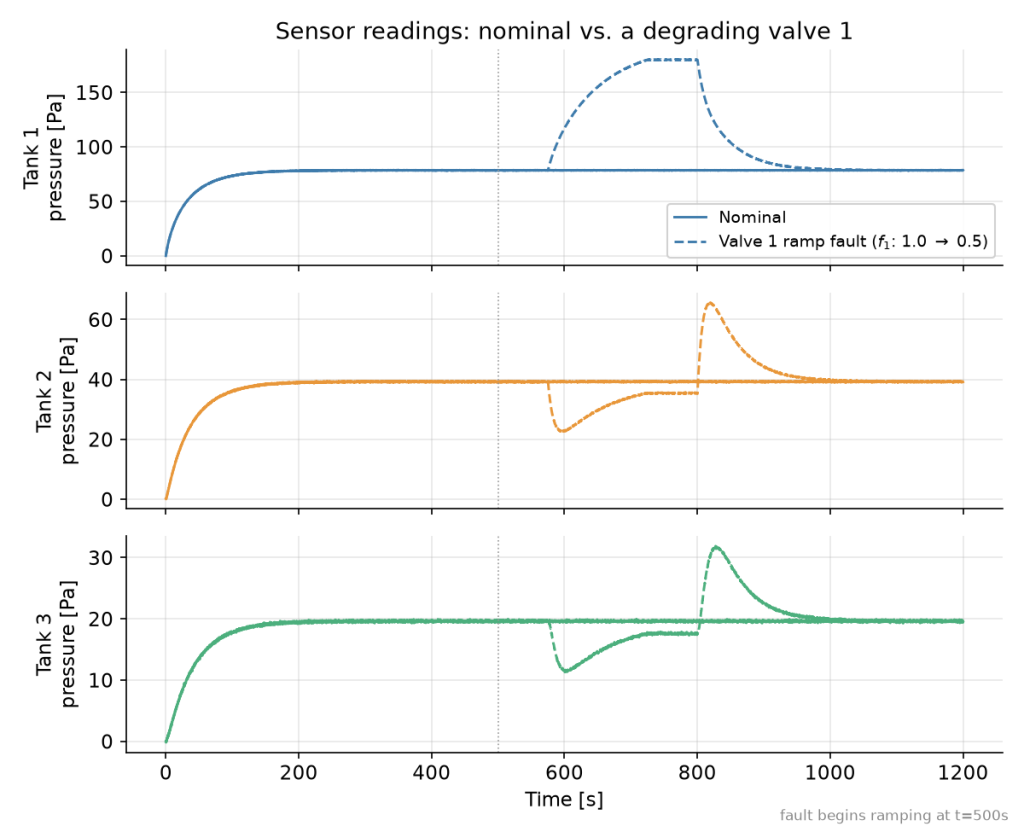
Valve 1 loses half its capacity for a few minutes, then recovers. That is all any method gets to see.
The filters consume raw readings online. The regressors cannot, so a rolling window over each sensor yields ten features apiece — min, max, mean and standard deviation in the time domain, plus six statistics over the window’s power spectrum.
I ran ten methods on one instance. Data-driven, trained once on the training scenarios: Decision Tree, Random Forest, Gradient Boosting, Linear and Ridge Regression, SVR, Multi-Layer Perceptron. Filter-based, with no training step at all, each carrying the ODEs forward in time and correcting against the sensors: Extended Kalman Filter, which linearises at each step; Unscented Kalman Filter, which propagates sample points through the exact nonlinear model instead; and a Particle Filter, deliberately under-provisioned at 50 particles (to save CPU time).
The Table
Method
Family
Isolation accuracy
MSE
CPU/scenario
Random Forest
Data-driven
0.975
0.003
0.037 s
Decision Tree
Data-driven
0.968
0.0054
0.005 s
Ridge Regression
Data-driven
0.844
0.0078
0.006 s
Linear Regression
Data-driven
0.835
0.0074
0.006 s
Multi-Layer Perceptron
Data-driven
0.762
0.0042
0.026 s
Gradient Boosting
Data-driven
0.708
0.0031
0.006 s
SVR
Data-driven
0.016
0.083
0.036 s
Unscented Kalman Filter
Filter-based
0.486
0.0203
25.5 s
Extended Kalman Filter
Filter-based
0.053
26.1
5.9 s
Particle Filter (50)
Filter-based
0.017
155.4
134.4 s
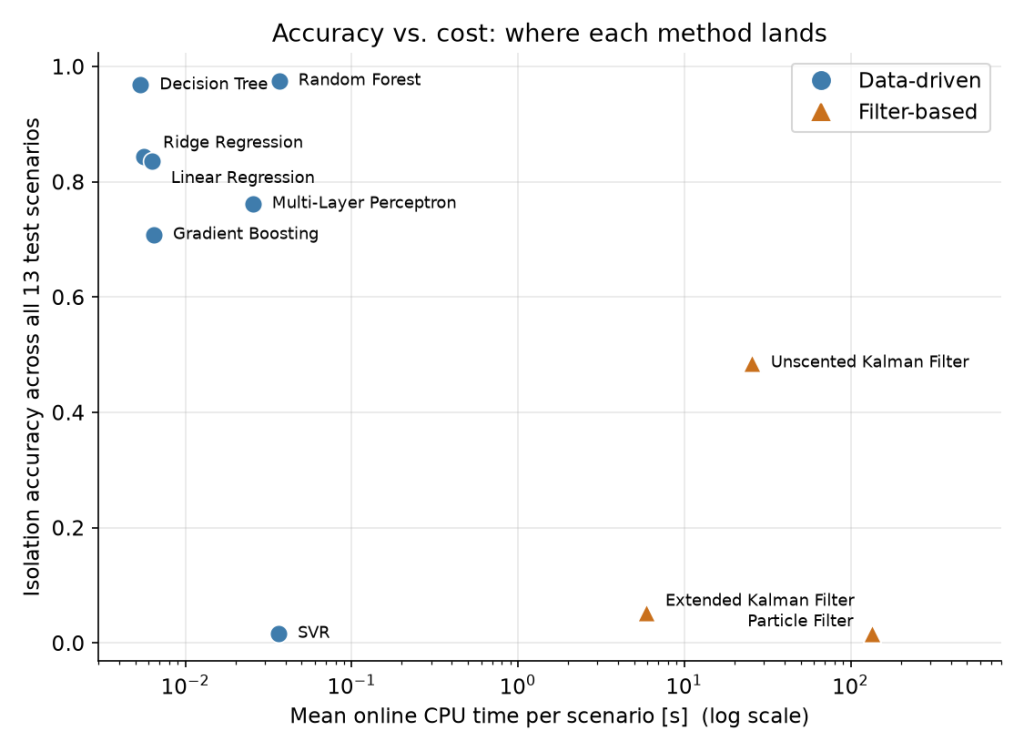
Two clusters, no overlap. The regressors pay for the model once, offline, in training; the filters pay every second of every scenario, because there is no training step to front-load the cost into. The whole study came to about half an hour of CPU on one machine — 81 percent of it the starved particle filter, while all seven data-driven methods together consumed under two seconds.
Three failures worth naming. The EKF diverges outright — that is \(\phi\) collecting its debt, the textbook failure of linearisation against strong nonlinearity, and exactly what the UKF exists to fix: same model, same scenarios, MSE some 1,300 times smaller. The particle filter was starved and behaved accordingly: 50 particles in a six-dimensional state space gives classic depletion, and it was still the most expensive thing on the board. SVR with sklearn defaults is no better than the starved filter. “Data-driven” is not a synonym for “accurate.”
Look closely at the Decision Tree, which wins the table. It holds flat at 1.0 through the entire descending ramp before jumping to the correct plateau, spikes to 0.2 when nothing is happening, and glitches once at \(t = 1090\,\text{s}\) in a fully recovered system. It is not tracking the dynamics. It is recognising a steady-state signature and binning it, extremely well. The UKF, at half the accuracy score, is estimating a continuous state and getting the shape roughly right. Different objects — which is why the toolkit reports eight metrics and not one.
Where the Labels Came From
The trees won, by a factor of two on accuracy and seven hundred on cost. This will surprise nobody who has worked in diagnosis. The interesting question is where the training data came from.
Those training scenarios do not exist in nature. Nobody has a record of a valve degrading to exactly 30 percent capacity with ground truth recorded alongside — as the maintenance vendors themselves concede, if pumps run ten years before failing you have almost no failure data. The regressors here were trained on scenarios simulated from the physical model, the same ODEs the filters integrate online. The model is load-bearing in both columns. The only thing that varies is when you pay for it.
Which makes the Random Forest a compiled, cached, lossy artefact of model-based diagnosis, fast for the reason a lookup table is fast. Strip the model away and there is no training set, and without a training set there is no forest. Yes, this is synthetic training data, and no, it is not the same activity as a frontier lab training on its own output: this generator is six equations, it conserves mass, its parameters were measured with a ruler and a stopwatch, and when it is wrong you can catch it against a physical system sitting right there. One of these arrangements can be audited by a second-year student with a bucket.
And the caveats have teeth. Every test fault came from the same generator as the training faults. Show that forest a stuck sensor, a leaking tank wall, or two simultaneous valve faults and it has nothing to generalize from, while the filters — never trained on anything — would at least attempt the right calculation. The forest cannot tell you why, cannot produce a certificate, and cannot report that it is out of its depth. It will simply answer.
Which returns us to those simulation scores. The EKF failed worse than almost anything here — and it failed legibly. The estimate climbed off the top of the chart and kept going. Nobody glancing at that plot on the way to lunch would mistake it for a diagnosis. It announced its own incompetence in the only language a diagnostic engine has, which is the shape of its output. A method that diverges is a method you can put an alarm on.
Next
psycho-killer is open source and the repository is live. Coming shortly: a video of the GUI doing all of the above, and guidelines for building it and pointing it at a system of your own.
After that, the direction of travel. Component-based hierarchical models, in the manner of Modelica — a plant assembled from reusable, nested components rather than hand-written as one flat set of equations, which is the only way this scales past three tanks to a refinery. A distributed web version, which will be paid, because the compute is not free and neither am I. And code generation: once the table tells you which method wins on your system, you get a deployable implementation of it rather than a recommendation. That is the whole arc — measure honestly, choose on evidence, ship the winner.
Ten methods. One model. Eight metrics. Half an hour of CPU, no gigawatts, and a table somebody else can check.
Ceterum censeo slopem esse delendam.
(Cato the Elder ended every speech in the Roman Senate with “Carthage must be destroyed” — regardless of the topic. This is that, but for AI slop.)
What those two studies share is not “AI is bad.” It is that a diagnostic method which cannot signal its own failure is worse than a mediocre one that can. Remember that; one of the ten methods below fails spectacularly, and the manner of its failure is the most reassuring thing in this post.
Sincerely yours is back from travels to his European lair, Delft where he went to talk about analog integrated circuits, diagnostics, design, and as the Dutch say “koetjes en kalfjes” (a very cute way to say, small talk). In the meanwhile, the AI chip company Cerebras pronounced its dinner-plate multi-core chips a success, went public and while I respect a bit the hardware nature of the business, cannot but recollect Vespasian’s words “Pecunia non olet” (money does not stink) when he imposed tax on urine. Of course, since the IPO, the stocks of the AI chip company in question started falling and somehow I have the feeling this is only the beginning. If I was of the Las Vegas inclination, I would short the AI. El Reg reported that Gemini was successfully used in a complicated scheme to steal crypto currency and it is of a minor curiosity that the crook prompted the engine in Russian while the responses were in English. Automation at its best.
On a less Friday-note I managed to extract an assurance from my TU Delft non-sycophantic human friends that a technology I am working on to provide better Verilog/VHDL technology mapping is not a total hallucination and has fleeting chances of success. More about this in an upcoming blog.
I also went to Delft and talked with a friend about Model-Based Diagnostics, something that used be an AI discipline before the chat-bots vulgarized the term AI. This friend knew about Lydia and the difficulty of modeling the real-world as a system of Boolean equations or a switching circuit. The same friend, didn’t know that after I finished my Ph.D. I spent quite some time figuring the analog alternative of Lydia and extending it.
As I wrote before, Lydia was a system for diagnosis of switching circuits. The process, was somewhat related to model checking. My task was to deal with the computational complexity, which, surprisingly, although very bad in the worst-case was never too bad in practice. Meaning, it was very difficult to come-up with a system that is difficult to diagnose.
The real-problem was, that switching circuits are mostly useful for modeling and designing digital circuits, state-machines, Von Neumann machines and in generals parts of computers. Switching circuits are no good for almost anything physics. This is related to the old debate of causation versus correlation, or the fact that there is no logical implication in physical systems. In other words, in physics and biology, almost everything is some kind of a circuit, almost always with feedback.
Lydia-NG is trying address the difficulty of modeling of physical systems. Of course, I had to provide compatibility with the old Lydia, so I was trying to define diagnosis as multiple simulations, with somewhat random configurations. The configurations that led to simulation predictions close to the actual measurements, would form the diagnostic hypotheses.
I managed to compile and run Lydia-NG and I am in the process of modernizing it. In addition to Boolean systems, Lydia-NG is capable of diagnosing and simulating systems of Ordinary Differential Equations (ODEs), and SPICE models of electrical circuits. SPICE models of electrical systems are somewhat more difficult systems of systems of Differential Algebraic Equations but about that I will talk another time.
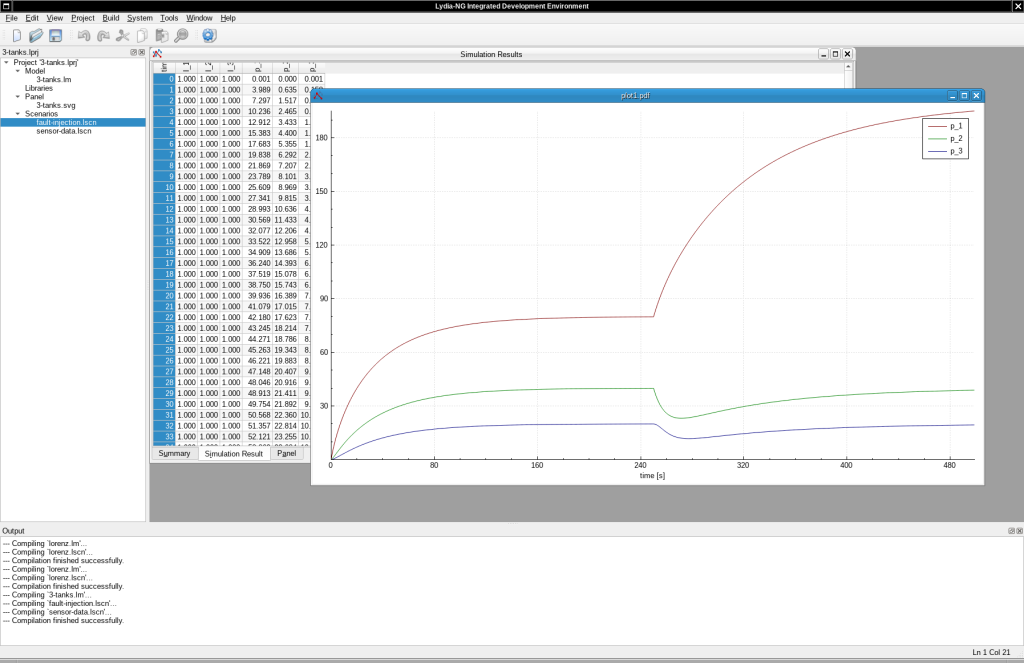
Lydia-NG is implemented in C++ and also has an IDE. Below is a simulation of the “Hello, world!” of diagnosis of a chemical system consisting of three connected vessels. You can see what happens whenever there is a leak.
I am in the process of modernizing and finishing Lydia-NG and it and I am thinking on how to release it–open source or otherwise. There is a whole lot to be said about diagnosis of equations and simulation of DAEs, there are also languages like Modelica and communities dedicated to the topic.
There is more to come when talking to state estimation, diagnosis, simulation, and continuous systems. I have implemented techniques like Kalman filters, variations of the latter like Extended and Unscented Kalman Filters (EKF and UKF), particle filters, and many others. Actually, at some point Xerox PARC was trying to prototype a system for diagnosis where tools such as Kalman filters were the core reasoning engine of diagnostics. But about this story, I will write another time.
In another non-development, my application for the South Park Commons, a place for kibitzers to raise money from the naive tech angel investors by talking nonsense, was denied. One can only think of Groucho Marx’s famous quote: “I refuse to join any club that would have me as a member.“
Field-Programmable Gate Arrays and the languages for programming (ahem, configuring them) have the reputation of being difficult to master. I still remember when I heard for the first time: at the beginning of my Ph.D. studies at TU Delft, a new friend of mine, visiting the computer engineering department, came home and told me he was supposed to implement some kind of GPS signal processing that required a lot of linear algebra operations with vectors and matrices (duh, isn’t all computing, including the insanely large vector matrix multiplication of LLMs, like that).
What stroke me at the time is that my friend thought he could just automatically translate Matlab code to VHDL (this is the European version of Verilog, for you Yankees) and benefit from the “micro-parallelism” of the platform. During this phase of my studies, I was already told that turning a sequential algorithm and making it parallel cannot be done by a machine.
But I am diverging. Years later, I still have problems with saying that we program FPGAs. Verilog, VHDL, and SystemC are not classical programming languages like C++ and Python. They have both declarative features for synthesis and procedural features for simulation and fancier techniques like model checking (here I come with my novel ideas and techniques). For the actual physical manifestation of an FPGA like transforming input electrical signals to output signals, the term “FPGA configuration” is more apt than programming. But a job ad for FPGA configurator would sound strange, thus FPGA programming it is!
Demo
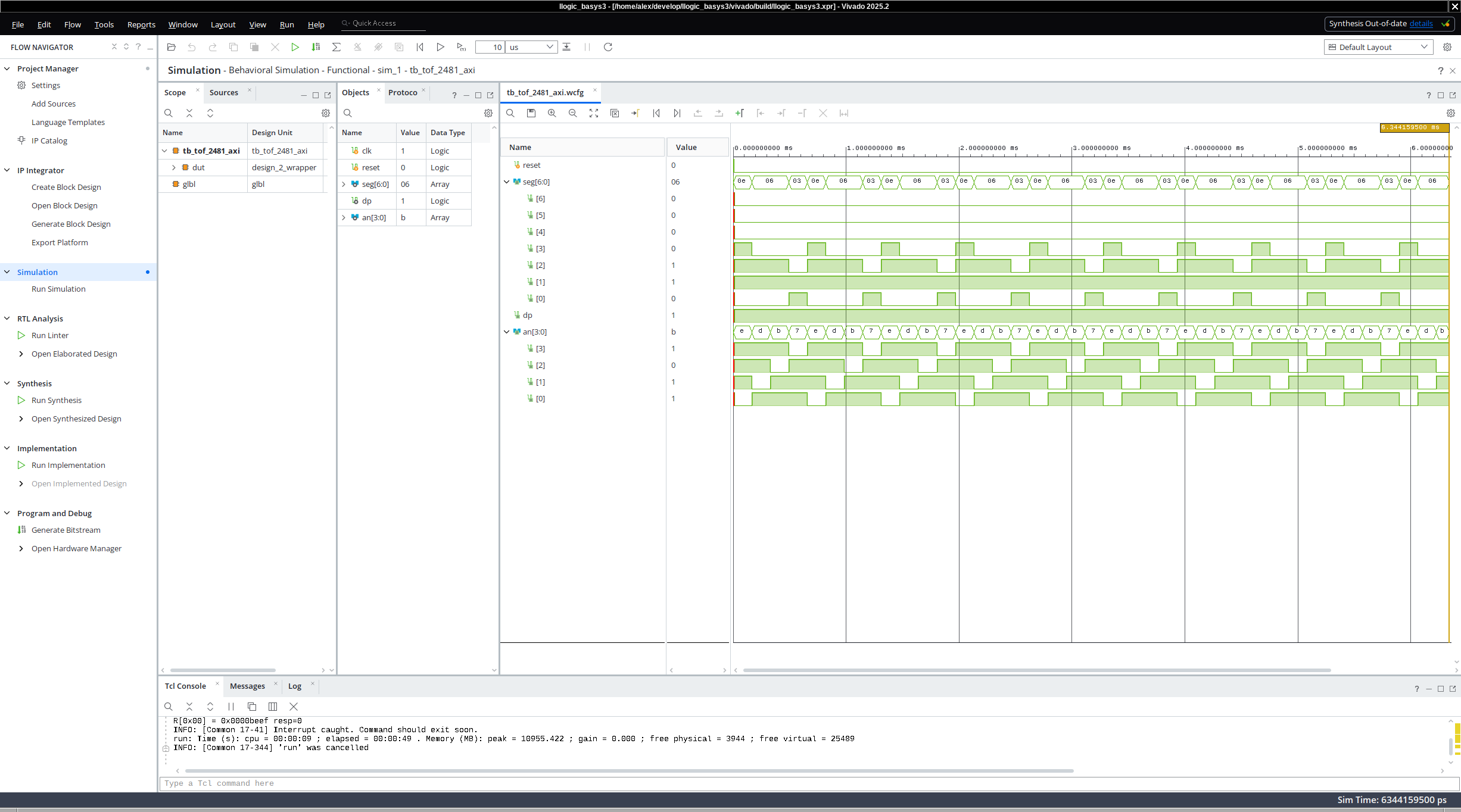
Let us fast-forward to the demo. I have felt numerous times the gusto of blinking a LED, so what could be better compared to a bunch of them. In the video below, you can see in action the auto-generated Verilog from the previous article combined with driving the 7-segment LED of the Basys-3.
Of course, this has been done sufficient times and is at the level of a high-school student, if it were not for the connection to the AXI bus, the behavioral simulation and the composition of IP blocks.
Composability and an AXI Architecture for Synthesis
In my previous article on the topic of FPGA, I showed that not all Verilog should be manually written. To do that, I went to implement common digital circuits in Python, saving them as DSLs and translating to Verilog. Of course, testing these circuits with real FPGA hardware requires a lot of infrastructure, and I used Vivado soft processor to do that. Vivado provides a quick graphical way to connect various IP blocks.
I will make a small deviation here. Although these days the boundaries between hardware and software are fuzzy, there is far less open-source hardware than open-source software. The reasons are, I believe, two: first, shipping hardware costs, on top of your time, also cash. The second reason, I believe, is more psychological: that developing hardware provides less instantenous gratification than developing software. That is why the building blocks of electronic chip design are called IP blocks where IP stands for Intellectual Property. Anyhow. Because companies still want to provide closed-source, obfuscated IP blocks, Vivado provides methods for composing these blocks into architectures. And if you want to be anybody in the chip making business you have to adhere to these practices.
One should always be suspicious of acronyms that have both the words Advanced and eXtnsible in them (the I in AXI stands for Interface). But this one is good. It is a part of AMBA and is a standard for chips to connect fast with each other. This is not unlike SPI or I2C, only faster and with many wires.
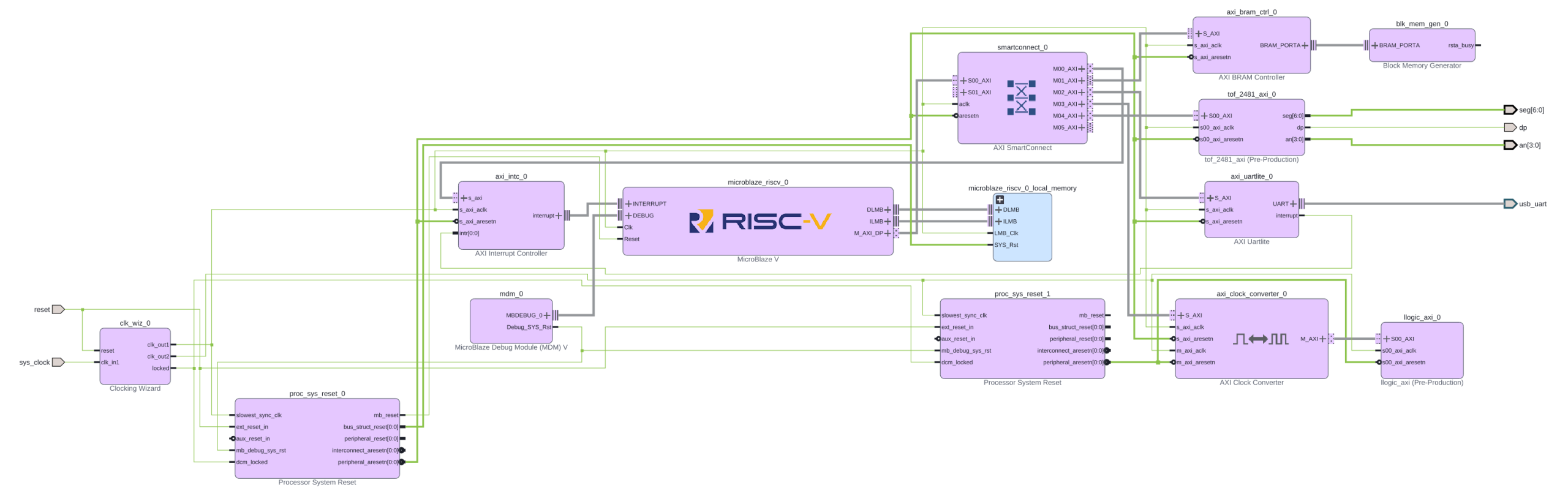
In the previous blog, I showed you the IP block diagram for the RISC-V architecture that uses autogenerated logic circuits. For the demo that follows, I have developed another IP block that drives the 7 segment LEDs of the Basys 3 development board. The new IP block diagram that includes this LED control block is shown below.
AXI Architecture for Simulation
Because simulation is distinct from synthesis, it is handy to have a separate Vivado block diagram for simulation. The reason is that we need a lot of infrastructure to generate the AXI bus signals, and this is already provided by the big players who have skin in the AXI game: AMD, ARM and the likes. It would be very difficult to toggle all AXI signals of a transaction by hand (remember that an AXI-compliant IP has tens of ports; one has to address a 32-bit address space, for example). Thankfully, this is already done by an IP block that contains only simulation code and is called “AXI Verification IP”. The resulting block diagram for the simulation is shown below.
It turns out that to connect to such a beast as an AXI-bus; it does not use the relatively basic simulation primitives of the original Verilog. One needs more abstraction, and it is provided by the dynamic extended features of System Verilog which extends the original Verilog for system verification. The code excerpt below shows the gist of the test-bench and illustrates how easy it is to generate an AXI transaction.
Having concocted the above test-bench for sending the input signals to the simulation of the AXI connected 7-segment LED display, we can click in Vivavdo, and lo-and-behold, wave-forms come out.
Of course, to perform even further testing and validation of the seven segment LEDs, one could convert the individual signals driving the LEDs to hexadecimals signals and could compare what the LEDs show to what the AXI master sent (in our case the hexadecimal value of 0xbeef). But the journey toward model checking, automatic diagnostics and testing is more interesting, and we have discussed LEDs more than enough.
Reflection
FPGA programming tool chains and Vivado are a hairball of design by committee, we do something this way because we did it the same way when we were young and when we used to bike ten miles to school every day (uphill both ways and into the wind). On the more positive side, these are complex tools, and they work, and people use them for their digital design.
All that being said, our understanding of both the theory and practice of computing has improved dramatically since the mid 20-th century, and it is time to revisit these old ways of designing and implementing circuits. If we do this carefully, maybe, maybe, we will design the hardware, software, and even AI algorithms that are not shameful to write about and use.
What is Next?
In what follows, we will grow our demo and I will show you how crappy the actual FPGA implementation that Vivado does. We will also discuss more accurate simulations, clocks, frequencies, timing analysis, and what proper AI algorithms (not the ones everybody is discussing but the ones that are not used for fraud and deception).
The Real Deal
Unlike what is these days practice in most of the Silicon Valley, everything I talk about is accessible and reproducible. So here is the repository that allowed me to write this blog article and make the demo: https://gitlab.llama.gs/llogic_basys3
Ceterum censeo slopem esse delendam.
(Cato the Elder ended every speech in the Roman Senate with “Carthage must be destroyed” — regardless of the topic. This is that, but for AI slop.)
Bitcoin miners are liquidating their holdings to pivot into AI hosting. The machines that wasted electricity producing imaginary money will now waste it producing imaginary intelligence. Anthropic has secured 3.5 gigawatts of compute — the consumption of three and a half million households — to serve language models.
GCC compiles the entire Linux kernel in fifteen minutes on a single machine drawing 200 watts. Fifty watt-hours. A light bulb left on for an afternoon. It manages this because it is not guessing. It has a grammar, a type system, and an optimisation pipeline where every transformation preserves semantics. There is no temperature parameter. There is no “try again and hope.”
A compiler’s cost is \(O(n \log n)\) in the size of the input. A language model’s cost is \(O(n \cdot d)\) where \(d\) is the dimensionality of a model that cannot tell you whether the answer is correct. When the task has a formal specification, you do not need gigawatts. You need a parser.
I have been writing parsers for twenty years. Today I started improving the one that matters most: the circuit description language at the heart of llogic, qbf-designer, and the formal methods toolchain I am building at Llama Logic.
My first encounter with a compiler was at Zend Technologies in Ramat Gan in 2000. I was twenty-two, fresh off the plane from Bulgaria, and I did not know what a parser was. Zend built the PHP language engine. I watched a small team turn a grammar into a working language that ran half the web. I did not understand how.
A few years later, at Delft, I read the Dragon Book and took the compiler construction course of Koen Langendoen. We became friends over my many years at the university. That course turned out to be one of the most useful things I have ever learned. It is the skill that lets me write software that works — not approximately, not statistically, not when the vibes are right, but deterministically, on all inputs, by construction.
It is also how I got into diagnosis. At the end of my master’s I went to Koen and asked for a Ph.D. position in compiler construction. He told me “compilers are passé” — but I could go work with Arjan J.C. van Gemund doing diagnostics. Arjan has since retired north to compose music, which is a better use of a fine mind than supervising Ph.D. students, though he was good at both. They needed a compiler for LyDiA, the diagnostic modelling language. So I built one. Then I built many more. Every research system I have worked on since — LyDiA, the DXC framework at NASA Ames, the synthesis tools at PARC, and now llogic — has a parser at its core. The compiler is never the point. The compiler is always the point.
A domain-specific language is a small language built for one job. SQL is a DSL for databases. Regular expressions are a DSL for pattern matching. Makefiles are a DSL for build dependencies. You do not write an operating system in SQL. You do not query a database with a Makefile. The language fits the problem, and because it fits, it can enforce constraints that a general-purpose language cannot.
This is the point that the vibe-coding movement misses entirely. A grammar is not a convenience. It is a contract. When I write a parser for a circuit description language, the grammar specifies exactly what constitutes a valid circuit. If you misspell a gate type, the parser rejects your input. If you connect an output to a nonexistent signal, the parser tells you. If you instantiate a module that does not exist, you get an error message with a line number — not a plausible-looking circuit that silently computes the wrong function.
This is what determinism means in practice. The parser either accepts or rejects. There is no 95% confidence. There is no temperature. The same input produces the same result every time, on every machine, for every user. A QBF solver receiving a malformed netlist will produce garbage. A diagnosis engine receiving an inconsistent model will compute meaningless results. The parser is the gate that keeps garbage out. It costs milliwatts. It works.
There is a second reason, less often discussed. Humans need to read these things. An engineer debugging a faulty adder needs to look at the circuit description and understand it. A reviewer verifying a synthesis result needs to confirm that the specification matches the intent. This is not a machine-to-machine format. It is a language — with the same design obligations as any language: clarity, consistency, and the ability to say exactly what you mean and nothing else.
The circuit DSL in llogic had outgrown its grammar. The new format adds modules, arrays, imports, and arbitrary nesting. A full adder, from primitives to a 4-bit module with array slicing:
# 4-bit ripple carry adder

import "std_logic.circ"

module half_adder(input a, b; output s, c):
    x: s = xor(a, b)
    a: c = and(a, b)
end

module full_adder(input a, b, ci; output s, co):
    wire f, p, q

    inst half_adder ha1(a=a, b=b, s=f, c=p)
    inst half_adder ha2(a=ci, b=f, s=s, c=q)
    o: co = or(p, q)
end

module adder2(input a[2], b[2], ci; output s[2], co):
    wire c0

    inst full_adder bit0(a=a[0], b=b[0], ci=ci, s=s[0], co=c0)
    inst full_adder bit1(a=a[1], b=b[1], ci=c0, s=s[1], co=co)
end

module adder4(input a[4], b[4], ci; output s[4], co):
    wire cm

    inst adder2 lo(a=a[0:1], b=b[0:1], ci=ci, s=s[0:1], co=cm)
    inst adder2 hi(a=a[2:3], b=b[2:3], ci=cm, s=s[2:3], co=co)
end
Four levels of nesting. Modules, arrays, slices, named connections. The flattener — a recursive tree walk, the same algorithm I used in LyDiA for system descriptions — traverses the instantiation tree and emits the flat netlist the solver has always consumed. The hierarchy is for the engineer. The solver does not know it exists.
Sequential circuits work the same way. A 4-bit serial adder with synchronous reset:
A dff with one argument is a plain register. Two arguments: synchronous reset. This maps directly to the standard Verilog template always @(posedge clk) if (rst) q <= 0; else q <= d; — making translation between the two languages mechanical.
So why not just use Verilog?
Because Verilog is a simulation language that has been coerced into serving as a synthesis input. A synthesis tool reads an always block, pattern-matches the sensitivity list, and infers what is a register and what is combinational logic. The engineer writes behaviour and hopes the tool’s heuristics match their intent. In llogic, a dff is a dff. An and is an and. There is no inference. The circuit says what it is.
This matters for formal methods. Diagnosis requires knowing exactly what components exist. Synthesis requires a precise specification of the design space. Neither tolerates a language that hides structure behind inference rules. Verilog is the right language for RTL designers who want to describe behaviour and let tools figure out the structure. Llogic is the right language when the structure is the point.
The parser, AST, and flattener should take a few days. When they are done I will update the llogic repository on the feature/hierarchical-dsl branch.
Three and a half million households’ worth of electricity to serve a model that cannot tell whether it is thinking deeply or not. Fifty watt-hours to compile a kernel. Considerably less to parse a circuit. The tools that work have always been quiet, small, and correct. The software will continue to not hallucinate.
Ceterum censeo slopem esse delendam.
(Cato the Elder ended every speech in the Roman Senate with “Carthage must be destroyed” — regardless of the topic. This is that, but for AI slop.)
This quarter, 4,500 CEOs told PwC their AI investments produced nothing. Separately, someone used AI to rewrite SQLite in Rust — 2,000 times slower. I have a cunning plan: what if we used computers to do actual computing?
Last week I said I was building a toolchain that goes from formal logic to real hardware. That post was a manifesto. This one is a receipt.
Seven days later: a full ALU — add, subtract, multiply, divide, integer factorization — running at 100MHz on a $150 Basys3 FPGA. UART command line with tab completion and history. No manual Verilog. No hand-optimized netlists. No venture capital. No pitch deck.
The arithmetic circuits are generated programmatically in llogic, translated to synthesizable Verilog by llogic2verilog, and deployed on a MicroBlaze soft processor over AXI4-Lite. The entire path from logical specification to working silicon is automated. One person, one week, open source.
The factor command brute-forces integer factorization by driving the multiplier at clock speed — 100 million candidates per second on a hobby board. Not a simulation. Not a testbench. Electrons moving through gates on a Xilinx Artix-7.
Nobody wrote this Verilog
That’s the point. Not the ALU — any undergraduate can write an adder. The point is that no human touched the HDL.
The circuit specifications live in llogic‘s DSL — a formal representation that spans Boolean formulas, CNF, circuits, and reversible/quantum circuits under one roof. lcfgen generates parameterized circuit families from that representation. llogic2verilog translates them to synthesizable Verilog. Vivado takes it the rest of the way.
Every step automated. Every component open source. No license fees, no NDAs, no EDA vendor lock-in.
What’s next
If you work on synthesis, hardware, or you’re funding research — the code is open and the board costs $150.
Next post: cryptographic circuit generators for DES and SHA, synthesized from the DSL, deployed to the FPGA. After that: an open-source architecture for SHA-1 collision hunting that makes Bitcoin’s address space look rather less comfortable. All designs public — because if the vulnerability exists, pretending otherwise is just poor manners. Any coins found can fund something useful. Clean energy. Quantum computing. Not espresso machines with a subscription model.
Ceterum censeo slopem esse delendam.
(Cato the Elder ended every speech in the Roman Senate with “Carthage must be destroyed” — regardless of the topic. This is that, but for AI slop.)